 gdz.by


Номер 2, страница 234 - гдз по английскому языку 9 класс учебник Лапицкая, Демченко

Авторы: Лапицкая Л. М., Демченко Н. В., Волков А. В., Калишевич А. И., Севрюкова Т. Ю., Юхнель Н. В.
Тип: Student's book (Учебник)
Издательство: Вышэйшая школа
Год издания: 2018 - 2025
Цвет обложки: синий
Допущено Министерством образования Республики Беларусь
Популярные ГДЗ в 9 классе













Unit 8. Means of communication. Lesson 7. Mobile phones – wolves in sheep‛s clothing? - номер 2, страница 234.
 №1
№1
№2 (с. 234)
Условие. №2 (с. 234)
скриншот условия
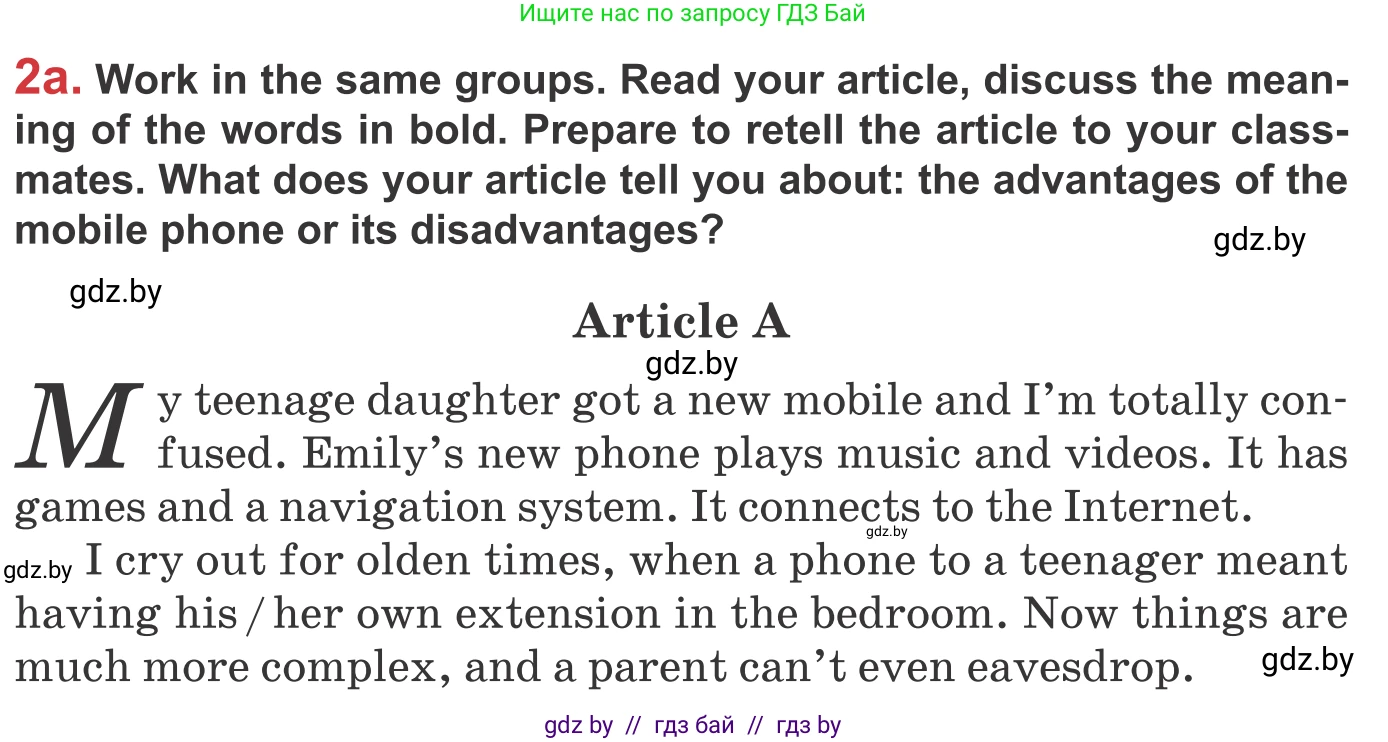
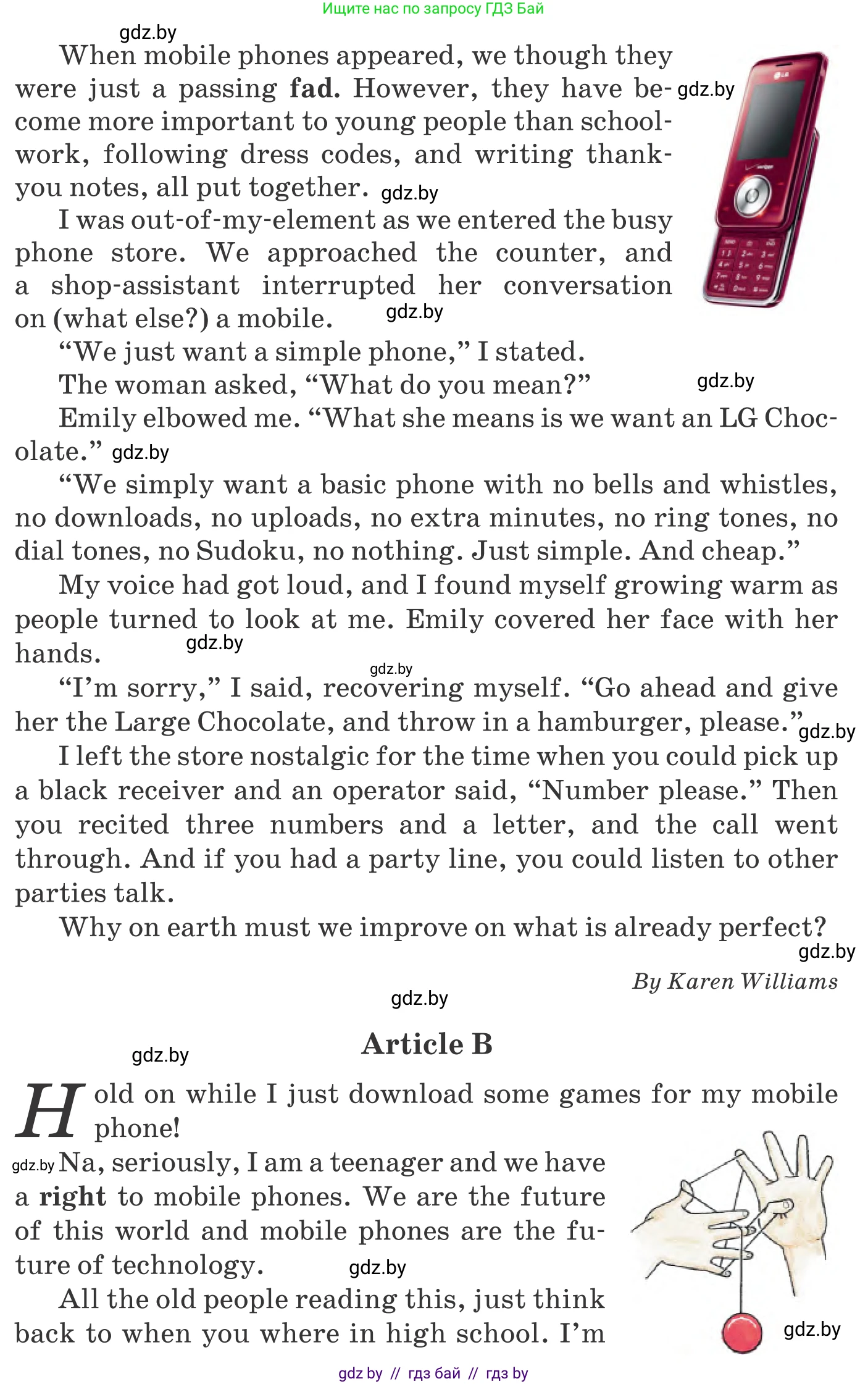
2a. Work in the same groups. Read your article, discuss the meaning of the words in bold. Prepare to retell the article to your class-mates. What does your article tell you about: the advantages of the mobile phone or its disadvantages?
Article A
My teenage daughter got a new mobile and I’m totally con-fused. Emily’s new phone plays music and videos. It has games and a navigation system. It connects to the Internet.
I cry out for olden times, when a phone to a teenager meant having his / her own extension in the bedroom. Now things are much more complex, and a parent can’t even eavesdrop.
When mobile phones appeared, we thought they were just a passing fad. However, they have be-come more important to young people than school-work, following dress codes, and writing thank-you notes, all put together.
I was out-of-my-element as we entered the busy phone store. We approached the counter, and a shop-assistant interrupted her conversation on (what else?) a mobile.
“We just want a simple phone,” I stated.
The woman asked, “What do you mean?”
Emily elbowed me. “What she means is we want an LG Choc-olate.”
“We simply want a basic phone with no bells and whistles, no downloads, no uploads, no extra minutes, no ring tones, no dial tones, no Sudoku, no nothing. Just simple. And cheap.”
My voice had got loud, and I found myself growing warm as people turned to look at me. Emily covered her face with her hands.
“I’m sorry,” I said, recovering myself. “Go ahead and give her the Large Chocolate, and throw in a hamburger, please.”
I left the store nostalgic for the time when you could pick up a black receiver and an operator said, “Number please.” Then you recited three numbers, and a letter – and the call went through. And if you had a party line, you could listen to other parties talk.
Why on earth must we improve on what is already perfect?
By Karen Williams
Article B
Hold on while I just download some games for my mobile phone!
Na, seriously, I am a teenager and we have a right to mobile phones. We are the future of this world and mobile phones are the fu-ture of technology.
All the old people reading this, just think back to when you where in high school. I’m
sure you had some trendy thing that older people disagreed with. Maybe it was a yo-yo or some weird thing you old people play with. Did you want to keep it or throw it away?
Phones are useful in more ways than you could even dream of, a lot more useful than your favourite yo-yo. Primarily they connect us to our friends that we can’t always talk to. Secondly they have games – ENTERTAINMENT! It could just be better than your old yo-yo! They also play music. Amazing, isn’t it!
That is the same with mobile phones: we love them even if older people disagree.
Power to the future!
P.S. LG Chocolate is a nice phone!
By Vincent Moore
Article C
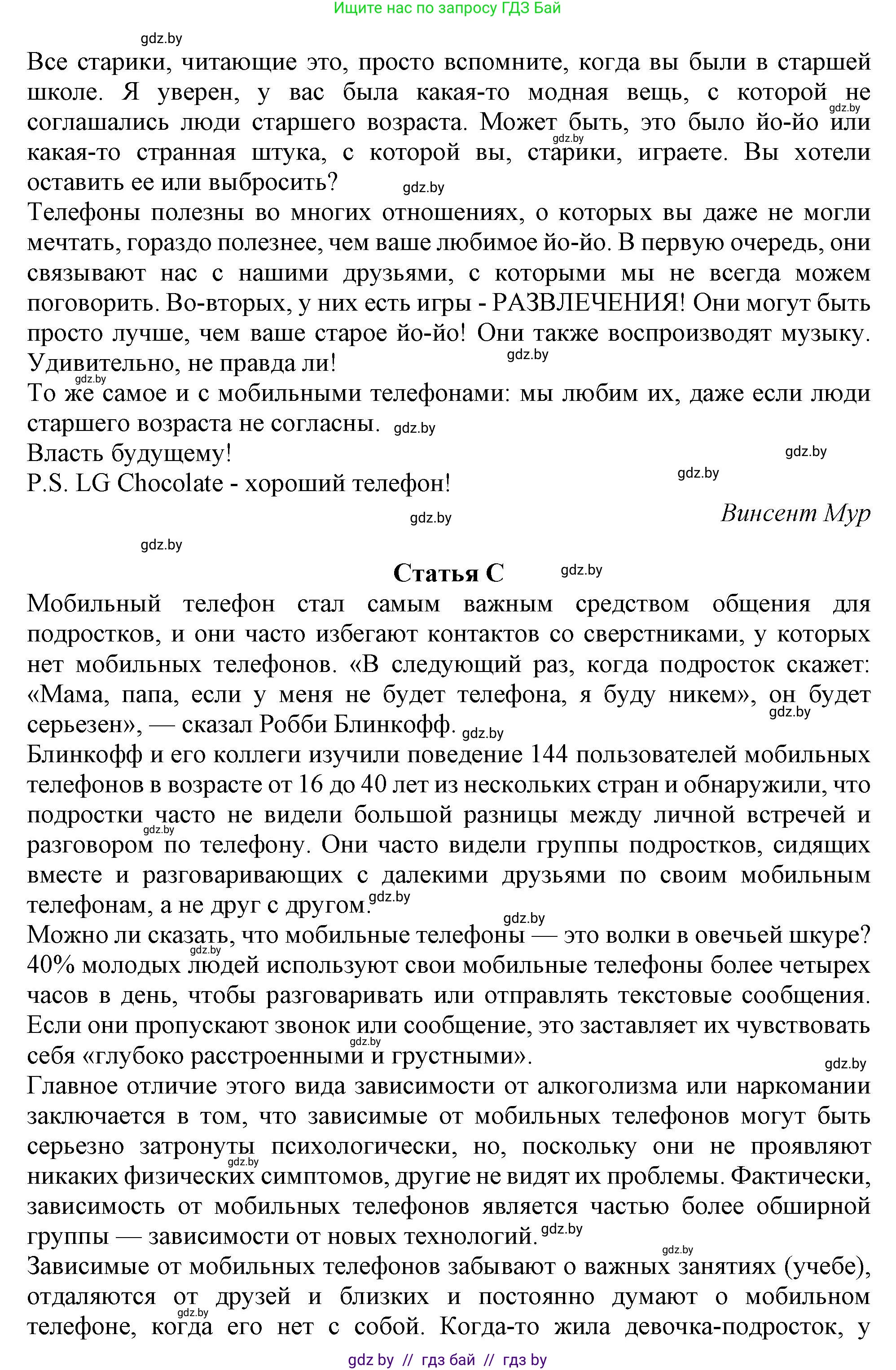
The mobile phone has become the most important way of communication for teens and they often avoid contact with peers that don’t have mobile phones. “Next time a teen-ager says, ‘Mom, Dad, if I don’t have a phone, I’m going to be a nobody’,” they are being serious, said Robbie Blinkoff.
Blinkoff and his colleagues studied the behaviour of 144 mobile phone users between the ages of 16 and 40 from several countries and found that teenagers often saw little difference between meeting face to face and talking on the phone. They of-ten saw groups of teenagers sitting together, talking with far-away friends on their mobiles rather than to each other.
Can we say that mobile phones are wolves in sheep’s cloth-ing?
40% of young adults use their mobile phones during more than four hours a day to talk or send text messages. If they miss a call or a message, it makes them feel “deeply upset and sad”.
The main difference between this kind of addiction and al-coholism or drug-addiction is that mobile-addicts can be seri-ously affected psychologically, but, as they don’t show any physical symptoms, others don’t see their problem. In fact, ad-diction to mobile phones is a part of a greater group – that of addiction to new technologies.
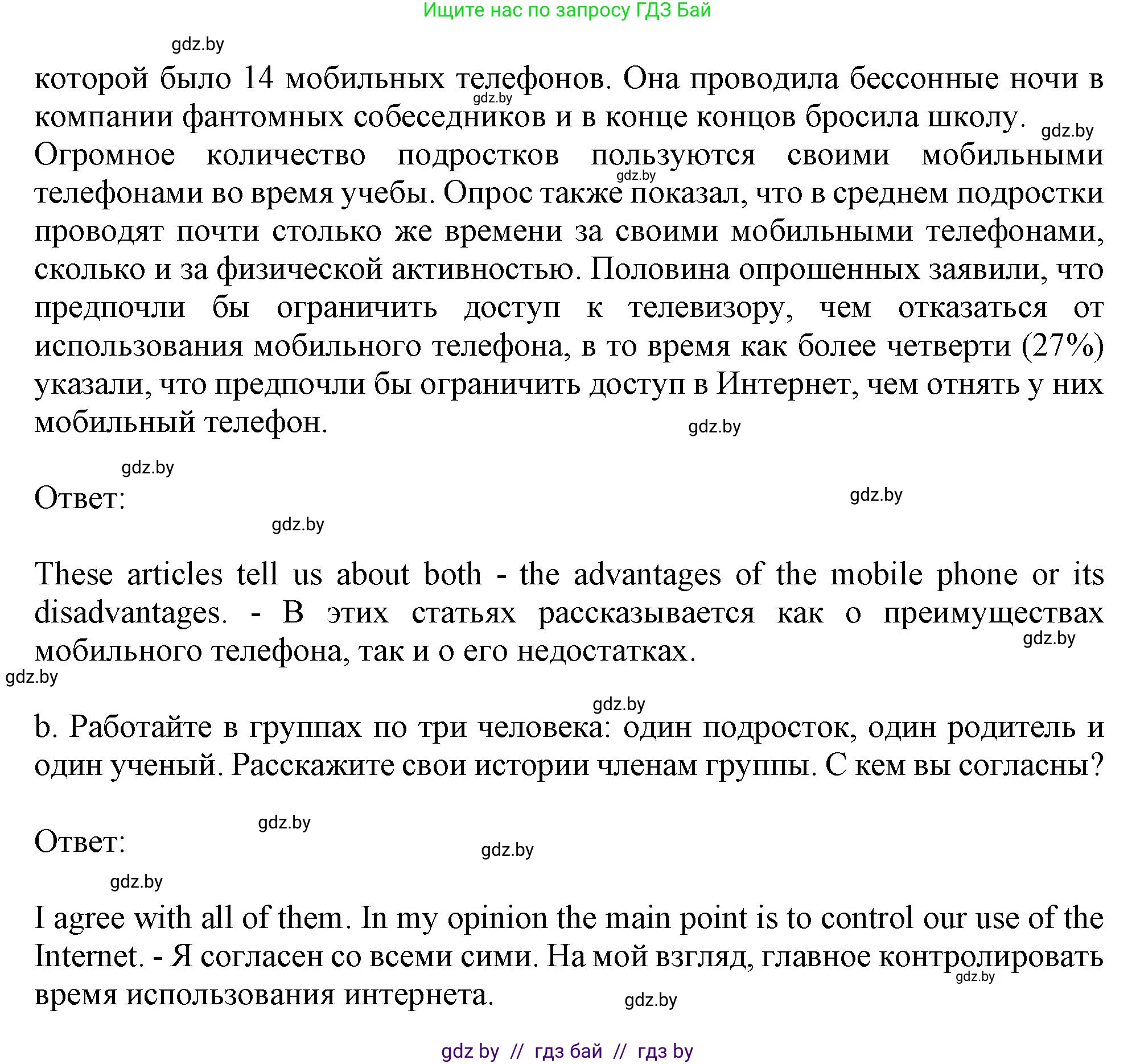
Mobile-addicts forget about important activities (studies), drift apart from friends and close family and think about the mobile phone constantly when they do not have it with them. There was once a teenager who had 14 mobile phones. She spent sleepless nights in the company of phantom chat partners and finally dropped out of school.
A huge number of teens use their mobile phones during school. The survey also revealed that on average, teens spend almost as much time on their mobile phones as they spend do-ing physical activity. One half of those surveyed said they would rather have their TV priv-ileges cut down than their mo-bile phone use, while more than a quarter (27%) indicated they would prefer to have Web access limited rather than have their mobile phones taken away.
2b. Work in groups of three: one teenager, one parent and one scien-tist. Tell your stories to the group members. Who do you agree with?
Решение 1. №2 (с. 234)
Решение 2. №2 (с. 234)

Решение 3. №2 (с. 234)
2a. О чем рассказывает ваша статья: о преимуществах мобильного телефона или о его недостатках?
Ответ:
Article A: This article focuses on the disadvantages of modern mobile phones from a parent's perspective, highlighting their complexity and the nostalgia for simpler times.
Article B: This article, from a teenager's viewpoint, emphasizes the advantages of mobile phones, such as connecting with friends, entertainment, and being part of future technology.
Article C: This article discusses the disadvantages of mobile phones, concentrating on issues like addiction, social isolation, and the negative impact on studies and family life.
Перевод:
Статья A: Эта статья посвящена недостаткам современных мобильных телефонов с точки зрения родителя, подчеркивая их сложность и ностальгию по более простым временам.
Статья B: Эта статья, с точки зрения подростка, подчеркивает преимущества мобильных телефонов, такие как общение с друзьями, развлечения и причастность к технологиям будущего.
Статья C: В этой статье обсуждаются недостатки мобильных телефонов, уделяя особое внимание таким проблемам, как зависимость, социальная изоляция и негативное влияние на учебу и семейную жизнь.
Другие задания:

Помогло решение? Оставьте отзыв в комментариях ниже.
Присоединяйтесь к Телеграм-группе @gdz_by_belarus
ПрисоединитьсяМы подготовили для вас ответ c подробным объяснением домашего задания по английскому языку за 9 класс, для упражнения номер 2 расположенного на странице 234 к Учебник (Student's book) 2018 года издания для учащихся школ и гимназий.
Теперь на нашем сайте ГДЗ.ТОП вы всегда легко и бесплатно найдёте условие с правильным ответом на вопрос «Как решить ДЗ» и «Как сделать» задание по английскому языку к упражнению №2 (с. 234), авторов: Лапицкая (Людмила Михайловна), Демченко (Наталья Валентиновна), Волков (Андрей Валерьевич), Калишевич (Алла Ивановна), Севрюкова (Татьяна Юрьевна), Юхнель (Наталья Валентиновна), учебного пособия издательства Вышэйшая школа.