 gdz.by


Номер 1, страница 83, часть 1 - гдз по английскому языку 10 класс учебник Демченко, Юхнель

Авторы: Демченко Н. В., Юхнель Н. В., Севрюкова Т. Ю., Бушуева Э. В., Лапицкая Л. М.
Тип: Student's book (Учебник)
Издательство: Вышэйшая школа
Год издания: 2021 - 2025
Уровень обучения: повышенный
Часть: 1
Цвет обложки: голубой
Допущено Министерством образования Республики Беларусь
Популярные ГДЗ в 10 классе










Часть 1. Unit 2. Education. Lesson 12. Progress check - номер 1, страница 83.
 №4
№4
№1 (с. 83)
Условие. №1 (с. 83)
скриншот условия

I. READING
1. Read the newspaper article and say in 2–3 sentences what it is about.
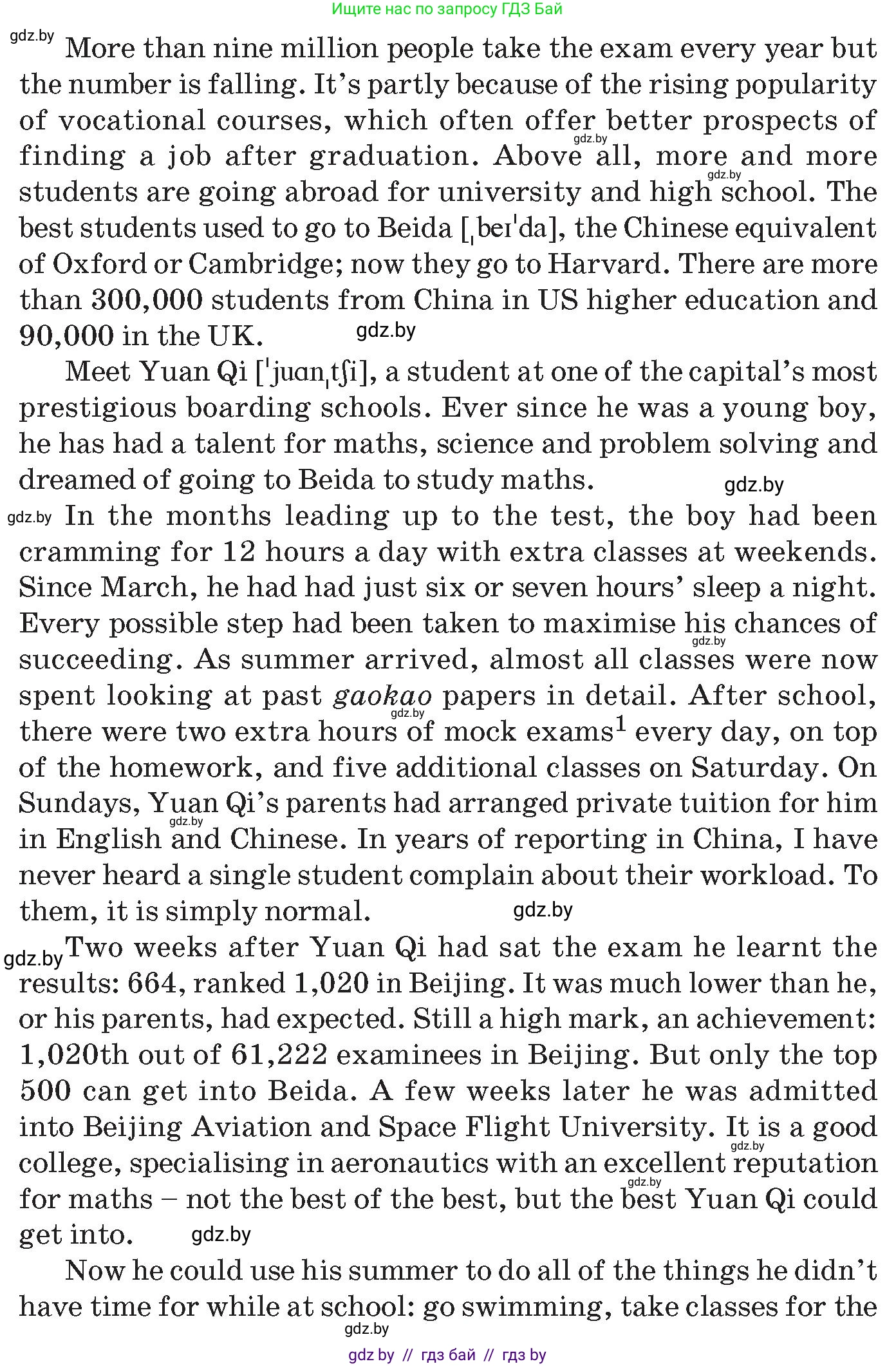
For two days in early June every year, China comes to a stop as high school students who are about to graduate take their college entrance exams. The national event can be compared with a public holiday, but much less fun. Construction work and traffic are stopped near examination halls. There are ambulances outside and police cars patrol to keep the streets quiet. Radio talk show hosts discuss the questions in detail and later congratulate those who have got the top scores. That score is the most important number of any Chinese child’s life, the culmination of years of schooling and stress.
While college entrance is competitive in any country, in China the top universities can select as few as one in 50,000 students. With so much to gain or lose, cheating is a big problem. Fingerprint has been used to check the identity of students. Exam papers are escorted to schools by security guards. According to new rules, cheats can be sent to prison for up to seven years.
The gaokao ['gau,kau] is made up of four three-hour papers: Chinese, English, maths and either sciences or humanities. There has been talk of reforming the exam for as long as it has existed, but little ever comes of it. And so, it still can make or break a young person’s future.
More than nine million people take the exam every year but the number is falling. It’s partly because of the rising popularity of vocational courses, which often offer better prospects of finding a job after graduation. Above all, more and more students are going abroad for university and high school. The best students used to go to Beida [,beɪ'da], the Chinese equivalent of Oxford or Cambridge; now they go to Harvard. There are more than 300,000 students from China in US higher education and 90,000 in the UK.
Meet Yuan Qi ['juan,tʃi], a student at one of the capital’s most prestigious boarding schools. Ever since he was a young boy, he has had a talent for maths, science and problem solving and dreamed of going to Beida to study maths.
In the months leading up to the test, the boy had been cramming for 12 hours a day with extra classes at weekends. Since March, he had had just six or seven hours’ sleep a night. Every possible step had been taken to maximise his chances of succeeding. As summer arrived, almost all classes were now spent looking at past gaokao papers in detail. After school, there were two extra hours of mock exams1 every day, on top of the homework, and five additional classes on Saturday. On Sundays, Yuan Qi’s parents had arranged private tuition for him in English and Chinese. In years of reporting in China, I have never heard a single student complain about their workload. To them, it is simply normal.
Two weeks after Yuan Qi had sat the exam he learnt the results: 664, ranked 1,020 in Beijing. It was much lower than he, or his parents, had expected. Still a high mark, an achievement: 1,020th out of 61,222 examinees in Beijing. But only the top 500 can get into Beida. A few weeks later he was admitted into Beijing Aviation and Space Flight University. It is a good college, specialising in aeronautics with an excellent reputation for maths – not the best of the best, but the best Yuan Qi could get into.
Now he could use his summer to do all of the things he didn’t have time for while at school: go swimming, take classes for the board game Go, learn how to ride a bike. And, now that it had served its purpose, his gaokao mark could be forgotten – like much of the knowledge he had memorised to achieve it. Yuan Qi still didn’t complain about the exam.
“I don’t feel disappointed so much as lost,” he said. “If it were just me, if I didn’t have parents, then I would feel a bit better. But why do I feel like it’s they who are the most disappointed? They had such high expectations.”
Решение. №1 (с. 83)


Решение 2. №1 (с. 83)
1. Прочтите газетную статью и в 2-3 предложениях скажите, о чем она.
Ответ:
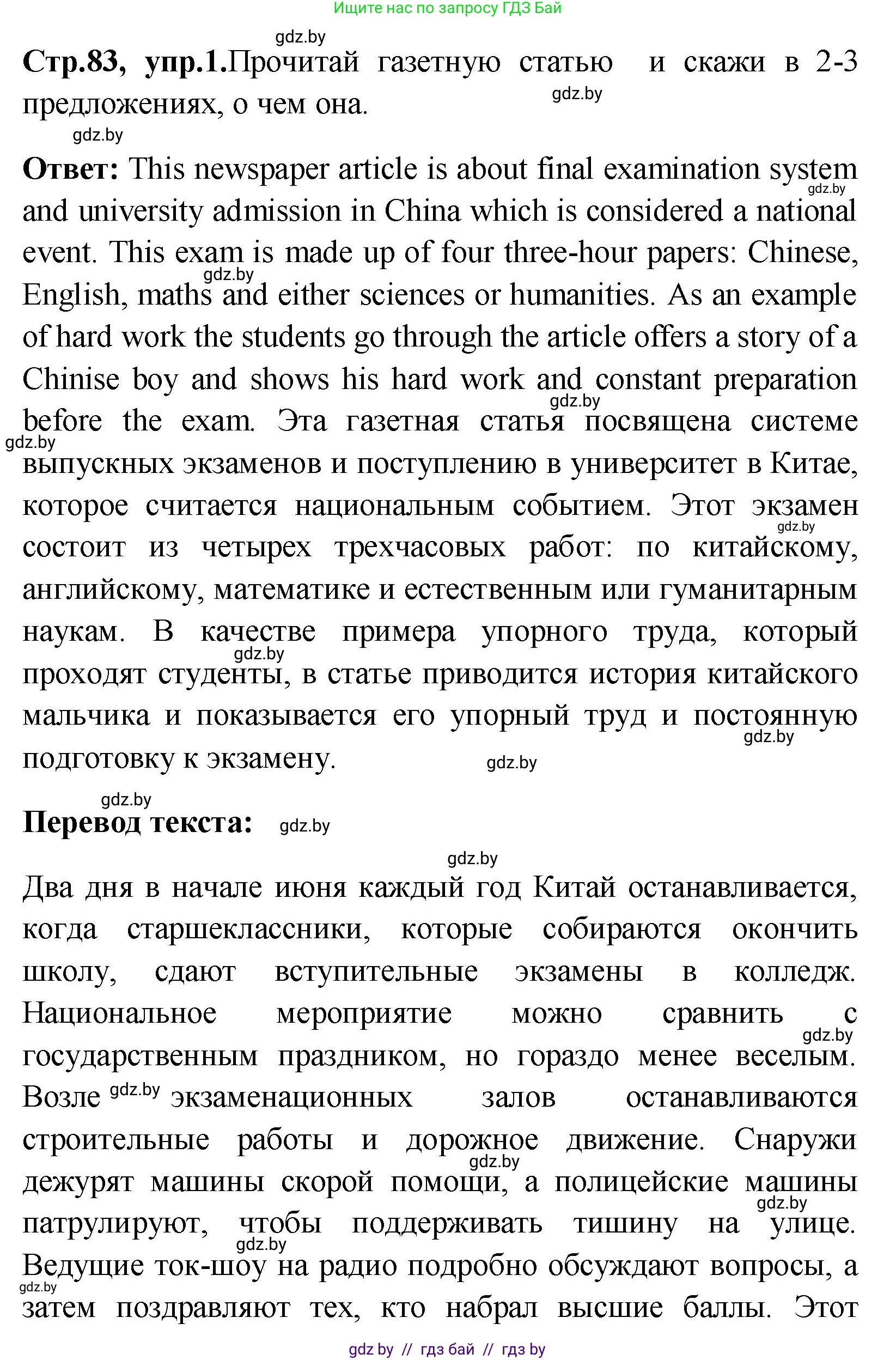
This article is about the gaokao, China's highly competitive and stressful national college entrance exam. It describes the intense preparations students undertake, the high stakes involved, and the story of one student, Yuan Qi, highlighting the immense pressure and the impact of the exam on students and their families.
Перевод:
Эта статья о гаокао — крайне конкурентном и напряженном национальном вступительном экзамене в колледжи Китая. В ней описываются интенсивная подготовка студентов, высокие ставки и история одного студента, Юань Ци, что подчеркивает огромное давление и влияние экзамена на учеников и их семьи.
Другие задания:

Помогло решение? Оставьте отзыв в комментариях ниже.
Присоединяйтесь к Телеграм-группе @gdz_by_belarus
ПрисоединитьсяМы подготовили для вас ответ c подробным объяснением домашего задания по английскому языку за 10 класс, для упражнения номер 1 расположенного на странице 83 для 1-й части к Учебник (Student's book) 2021 года издания для учащихся школ и гимназий.
Теперь на нашем сайте ГДЗ.ТОП вы всегда легко и бесплатно найдёте условие с правильным ответом на вопрос «Как решить ДЗ» и «Как сделать» задание по английскому языку к упражнению №1 (с. 83), авторов: Демченко (Наталья Валентиновна), Юхнель (Наталья Валентиновна), Севрюкова (Татьяна Юрьевна), Бушуева (Эдите Владиславовна), Лапицкая (Людмила Михайловна), 1-й части повышенный уровень обучения учебного пособия издательства Вышэйшая школа.