 gdz.by


Номер 2, страница 91, часть 2 - гдз по английскому языку 10 класс учебник Демченко, Юхнель
Авторы: Демченко Н. В., Юхнель Н. В., Севрюкова Т. Ю., Бушуева Э. В., Лапицкая Л. М.
Тип: Student's book (Учебник)
Издательство: Вышэйшая школа
Год издания: 2021 - 2025
Уровень обучения: повышенный
Часть: 2
Цвет обложки: голубой
Допущено Министерством образования Республики Беларусь
Популярные ГДЗ в 10 классе


Часть 2. Unit 7. Great people. Lesson 3. To be or not to be like Leonardo? - номер 2, страница 91.
 №1
№1
№2 (с. 91)
Условие. №2 (с. 91)
скриншот условия

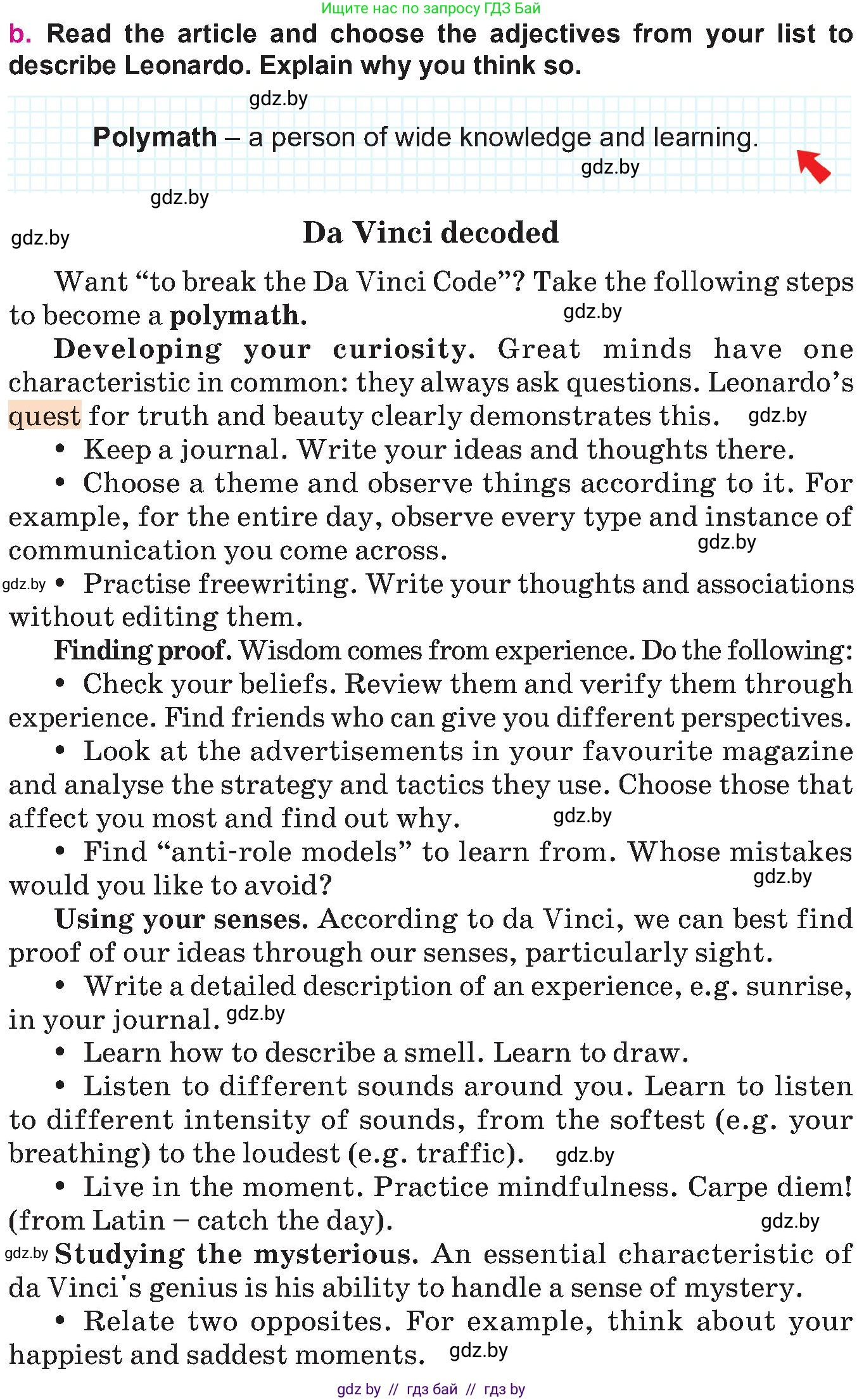

2. a. Brainstorm adjectives that can describe a genius. Write them up on the board
b. Read the article and choose the adjectives from your list to describe Leonardo. Explain why you think so.
Polymath – a person of wide knowledge and learning.
Da Vinci decoded
Want “to break the Da Vinci Code”? Take the following steps to become a polymath.
Developing your curiosity. Great minds have one characteristic in common: they always ask questions. Leonardo’s quest for truth and beauty clearly demonstrates this.
• Keep a journal. Write your ideas and thoughts there.
• Choose a theme and observe things according to it. For example, for the entire day, observe every type and instance of communication you come across.
• Practise freewriting. Write your thoughts and associations without editing them.
Finding proof. Wisdom comes from experience. Do the following:
• Check your beliefs. Review them and verify them through experience. Find friends who can give you different perspectives.
• Look at the advertisements in your favourite magazine and analyse the strategy and tactics they use. Choose those that affect you most and find out why.
• Find “anti-role models” to learn from. Whose mistakes would you like to avoid?
Using your senses. According to da Vinci, we can best find proof of our ideas through our senses, particularly sight.
• Write a detailed description of an experience, e.g. sunrise, in your journal.
• Learn how to describe a smell. Learn to draw.
• Listen to different sounds around you. Learn to listen to different intensity of sounds, from the softest (e.g. your breathing) to the loudest (e.g. traffic).
• Live in the moment. Practice mindfulness. Carpe diem! (from Latin – catch the day).
Studying the mysterious. An essential characteristic of da Vinci’s genius is his ability to handle a sense of mystery.
• Relate two opposites. For example, think about your happiest and saddest moments.
• Practise the Socratic method by asking questions, not giving answers. Don’t assume that you or anyone knows anything for sure. Question every idea or theory.
Relating Art and Science. It is about “the development of the balance between science and art, logic and imagination”. This is thinking with the “whole brain”. Mind mapping is a powerful method that can help you combine logic and imagination in your work and life. The end result of mapping should be a web-like structure of words and ideas that are somehow related in the writer’s mind.
Knowing your body and keeping fit. Leonardo had amazing physical ability that complemented his genius in science and arts. Here is how you could keep fit:
• Develop your physical fitness: do flexibility, strength and aerobic exercises.
• Develop body awareness. Study anatomy. Try yoga. Dance. Do some contact juggling. Strengthen the connection between body and mind.
• Leonardo could work with both his right and left hand and regularly switched between them. Cultivate ambidexterity by using your non-dominant hand for relatively simple tasks first, like brushing your teeth or eating your breakfast and later for writing.
Making connections. One main source of Leonardo’s creativity is his ability to ...
• link things that seem unrelated, e.g. geology and the Mona Lisa;
• think about how things originate. Take an object and think about what elements are involved in its creation and how.
Some other characteristics of Leonardo da Vinci that might be worth your attention are: charisma, generosity, love of nature, love of animals and the curiosity of a child.
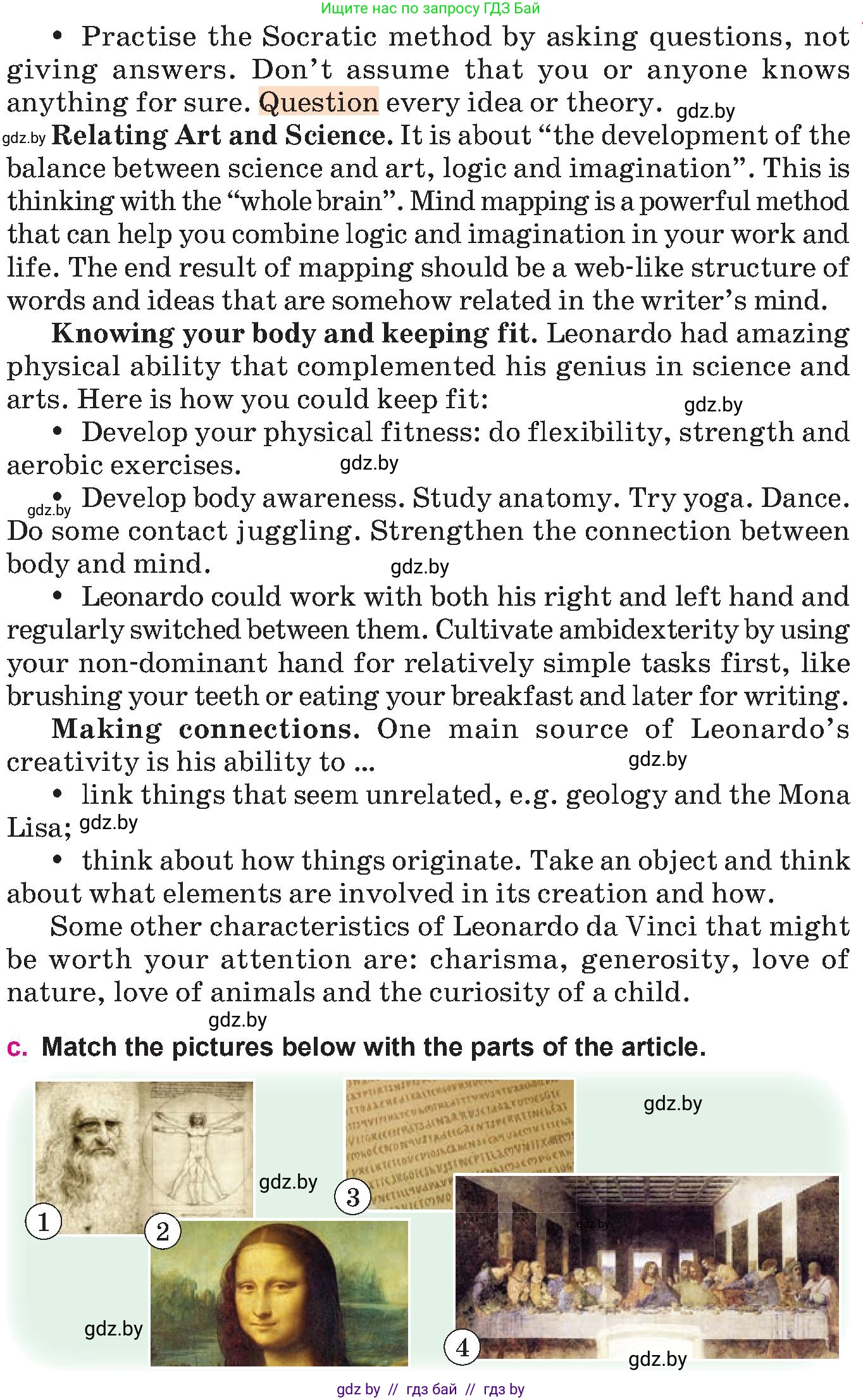
c. Match the pictures below with the parts of the article.
d. Which piece of advice seems the most sensible? Which piece of advice would you find the most difficult to follow?
Решение 2. №2 (с. 91)
2.b. Прочитайте статью и выберите прилагательные, которые описывают Леонардо. Объясните, почему вы так думаете.
Ответ: Based on the article, adjectives to describe Leonardo da Vinci include:
Curious: The text highlights his "quest for truth and beauty" and "the curiosity of a child."
Creative: His ability "to link things that seem unrelated" is mentioned as a source of his creativity.
Observant: The article advises to "observe things" and use the senses, especially sight, a practice of Leonardo's.
Ambidextrous: It is explicitly stated that "Leonardo could work with both his right and left hand."
Charismatic and Generous: These are listed among his other notable characteristics.
Mysterious: His "ability to handle a sense of mystery" is described as an essential characteristic of his genius.
Перевод:
Исходя из статьи, прилагательные, описывающие Леонардо да Винчи, включают:
Любознательный: В тексте подчеркивается его "стремление к истине и красоте" и "детское любопытство".
Творческий: Его способность "связывать вещи, которые кажутся несвязанными", упоминается как источник его творчества.
Наблюдательный: Статья советует "наблюдать за вещами" и использовать чувства, особенно зрение, что было практикой Леонардо.
Амбидекстр: Прямо указано, что "Леонардо мог работать как правой, так и левой рукой".
Харизматичный и щедрый: Эти качества перечислены среди других его примечательных характеристик.
Загадочный: Его "способность справляться с ощущением тайны" описывается как существенная характеристика его гения.
c. Соотнесите изображения ниже с частями статьи.
Ответ:
| Picture 1 (Self-portrait and Vitruvian Man) | The portrait represents the genius himself, while the Vitruvian Man directly relates to "Knowing your body and keeping fit" and "Relating Art and Science". |
| Picture 2 (Mona Lisa) | Relates to "Studying the mysterious" and "Making connections" (e.g., geology and the portrait). |
| Picture 3 (Journal/Codex) | Relates to "Developing your curiosity" (Keep a journal) and cultivating ambidexterity. |
| Picture 4 (The Last Supper) | Relates to "Using your senses" and "Relating Art and Science". |
Перевод:
| Изображение 1 (Автопортрет и Витрувианский человек) | Портрет представляет самого гения, в то время как Витрувианский человек напрямую относится к разделам "Знание своего тела и поддержание формы" и "Связь искусства и науки". |
| Изображение 2 (Мона Лиза) | Относится к разделам "Изучение таинственного" и "Создание связей" (например, геология и портрет). |
| Изображение 3 (Журнал/Кодекс) | Относится к разделу "Развитие любознательности" (Вести дневник) и развитию амбидекстрии. |
| Изображение 4 (Тайная вечеря) | Относится к разделам "Использование своих чувств" и "Связь искусства и науки". |
d. Какой совет кажется наиболее разумным? Какой совет, по вашему мнению, было бы сложнее всего выполнить?
Ответ:
The most sensible advice: "Keep a journal." It is a practical and effective way to organize thoughts, develop ideas, and practice observation, which are fundamental to many other skills mentioned.
The most difficult advice: "Cultivate ambidexterity" by using the non-dominant hand for complex tasks like writing. This requires immense, long-term dedication to retrain fine motor skills and can be very frustrating for most people.
Перевод:
Самый разумный совет: "Ведите дневник". Это практичный и эффективный способ упорядочить мысли, развить идеи и практиковать наблюдательность, что является основой для многих других упомянутых навыков.
Самый сложный для выполнения совет: "Развивайте амбидекстрию", используя недоминирующую руку для сложных задач, таких как письмо. Это требует огромной, долгосрочной самоотдачи для переучивания мелкой моторики и может быть очень фрустрирующим для большинства людей.
Другие задания:

Помогло решение? Оставьте отзыв в комментариях ниже.
Присоединяйтесь к Телеграм-группе @gdz_by_belarus
ПрисоединитьсяМы подготовили для вас ответ c подробным объяснением домашего задания по английскому языку за 10 класс, для упражнения номер 2 расположенного на странице 91 для 2-й части к Учебник (Student's book) 2021 года издания для учащихся школ и гимназий.
Теперь на нашем сайте ГДЗ.ТОП вы всегда легко и бесплатно найдёте условие с правильным ответом на вопрос «Как решить ДЗ» и «Как сделать» задание по английскому языку к упражнению №2 (с. 91), авторов: Демченко (Наталья Валентиновна), Юхнель (Наталья Валентиновна), Севрюкова (Татьяна Юрьевна), Бушуева (Эдите Владиславовна), Лапицкая (Людмила Михайловна), 2-й части повышенный уровень обучения учебного пособия издательства Вышэйшая школа.