 gdz.by


Номер 2, страница 98, часть 2 - гдз по английскому языку 10 класс учебник Демченко, Юхнель
Авторы: Демченко Н. В., Юхнель Н. В., Севрюкова Т. Ю., Бушуева Э. В., Лапицкая Л. М.
Тип: Student's book (Учебник)
Издательство: Вышэйшая школа
Год издания: 2021 - 2025
Уровень обучения: повышенный
Часть: 2
Цвет обложки: голубой
Допущено Министерством образования Республики Беларусь
Популярные ГДЗ в 10 классе


Часть 2. Unit 7. Great people. Lesson 5. Born or made? - номер 2, страница 98.
 №1
№1
№2 (с. 98)
Условие. №2 (с. 98)
скриншот условия
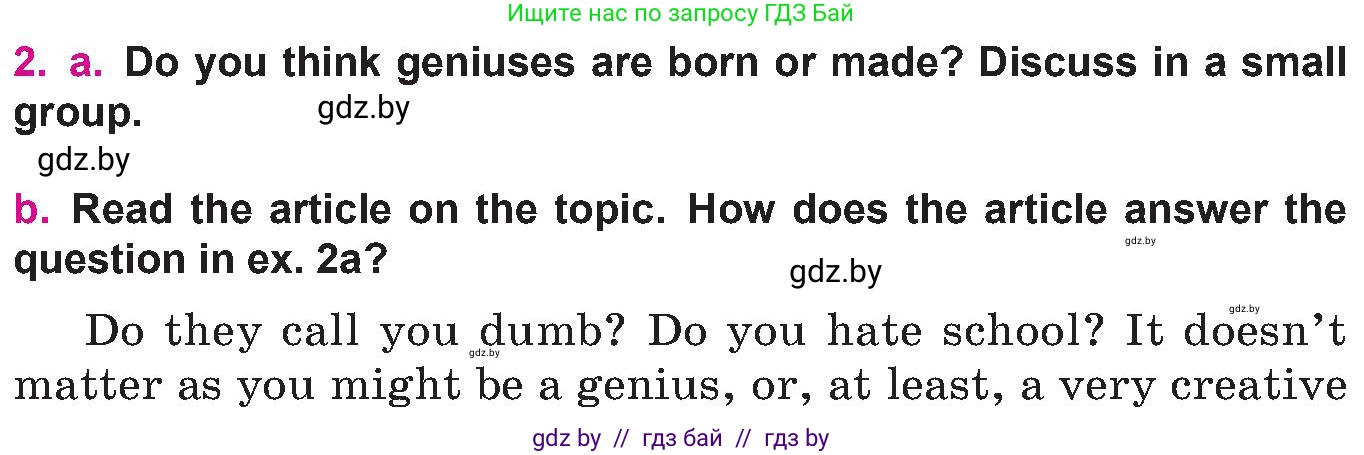
2. a. Do you think geniuses are born or made? Discuss in a small group.
b. Read the article on the topic. How does the article answer the question in ex. 2a?
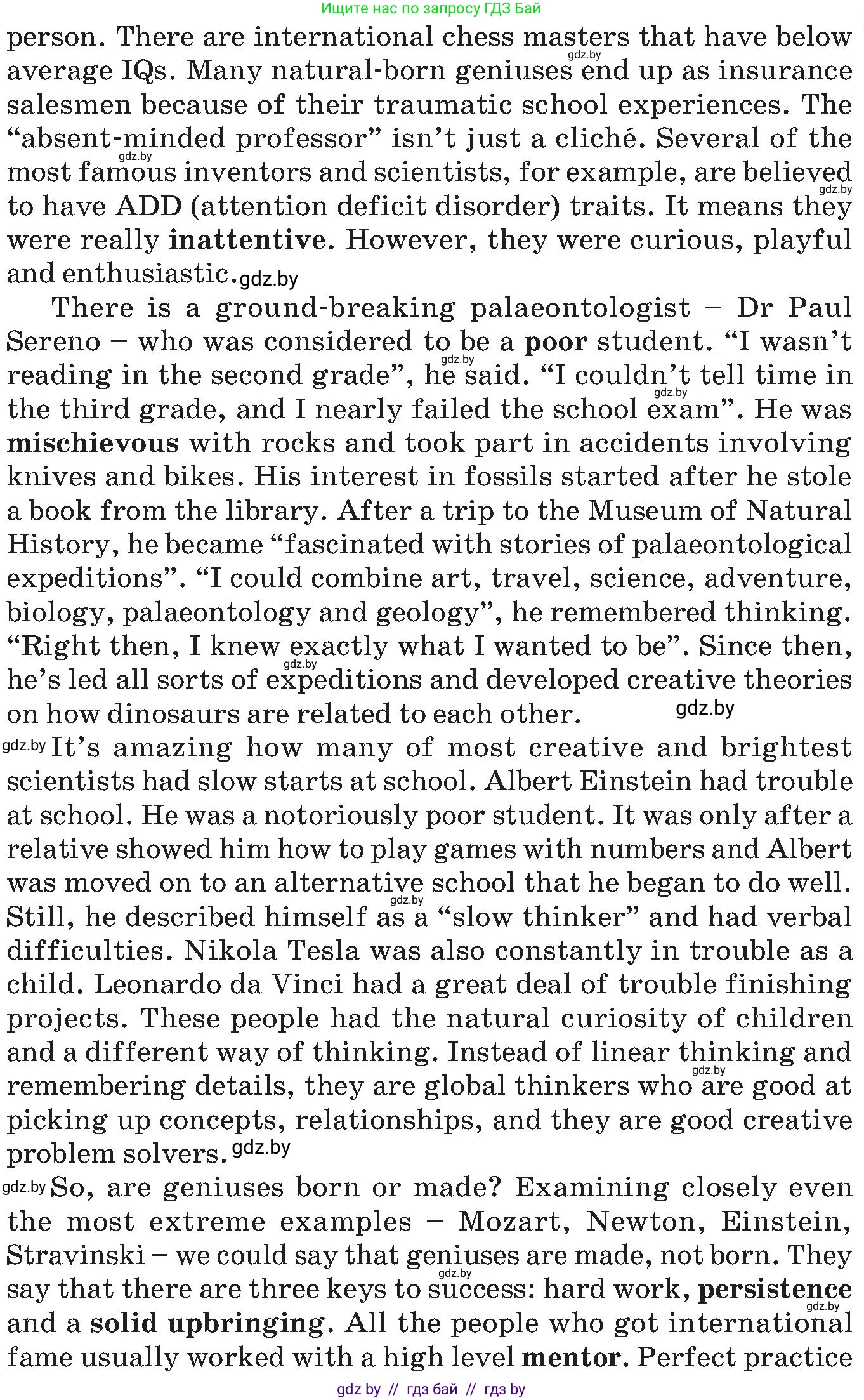
Do they call you dumb? Do you hate school? It doesn't matter as you might be a genius, or, at least, a very creative person. There are international chess masters that have below average IQs. Many natural-born geniuses end up as insurance salesmen because of their traumatic school experiences. The “absent-minded professor” isn't just a cliché. Several of the most famous inventors and scientists, for example, are believed to have ADD (attention deficit disorder) traits. It means they were really inattentive. However, they were curious, playful and enthusiastic.
There is a ground-breaking palaeontologist – Dr Paul Sereno – who was considered to be a poor student. “I wasn't reading in the second grade”, he said. “I couldn't tell time in the third grade, and I nearly failed the school exam”. He was mischievous with rocks and took part in accidents involving knives and bikes. His interest in fossils started after he stole a book from the library. After a trip to the Museum of Natural History, he became “fascinated with stories of palaeontological expeditions”. “I could combine art, travel, science, adventure, biology, palaeontology and geology”, he remembered thinking. “Right then, I knew exactly what I wanted to be”. Since then, he's led all sorts of expeditions and developed creative theories on how dinosaurs are related to each other.
It's amazing how many of most creative and brightest scientists had slow starts at school. Albert Einstein had trouble at school. He was a notoriously poor student. It was only after a relative showed him how to play games with numbers and Albert was moved on to an alternative school that he began to do well. Still, he described himself as a “slow thinker” and had verbal difficulties. Nikola Tesla was also constantly in trouble as a child. Leonardo da Vinci had a great deal of trouble finishing projects. These people had the natural curiosity of children and a different way of thinking. Instead of linear thinking and remembering details, they are global thinkers who are good at picking up concepts, relationships, and they are good creative problem solvers.
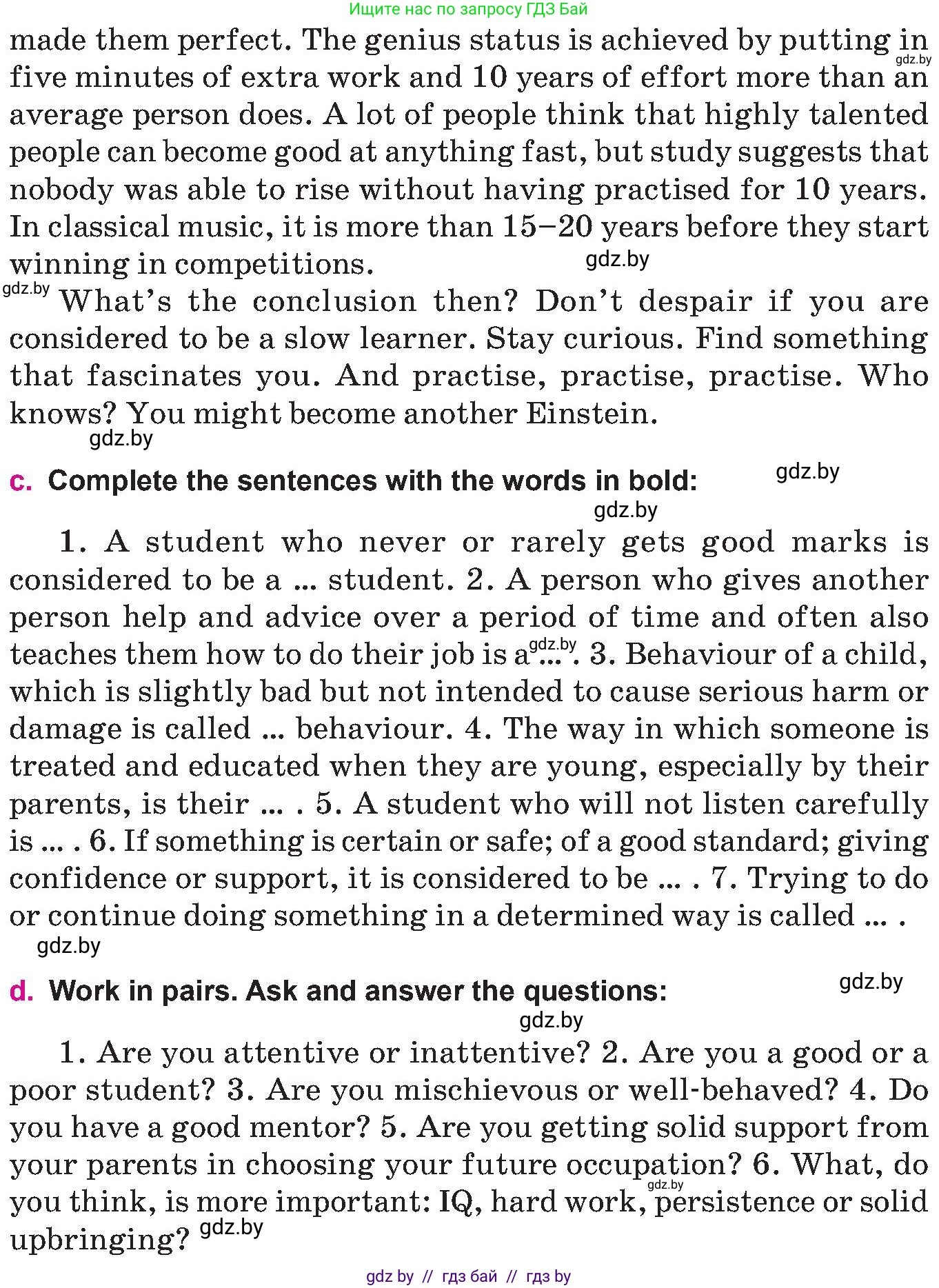
So, are geniuses born or made? Examining closely even the most extreme examples – Mozart, Newton, Einstein, Stravinski – we could say that geniuses are made, not born. They say that there are three keys to success: hard work, persistence and a solid upbringing. All the people who got international fame usually worked with a high level mentor. Perfect practice made them perfect. The genius status is achieved by putting in five minutes of extra work and 10 years of effort more than an average person does. A lot of people think that highly talented people can become good at anything fast, but study suggests that nobody was able to rise without having practised for 10 years. In classical music, it is more than 15–20 years before they start winning in competitions.
What's the conclusion then? Don't despair if you are considered to be a slow learner. Stay curious. Find something that fascinates you. And practise, practise, practise. Who knows? You might become another Einstein.
c. Complete the sentences with the words in bold:
1. A student who never or rarely gets good marks is considered to be a ... student. 2. A person who gives another person help and advice over a period of time and often also teaches them how to do their job is a ... . 3. Behaviour of a child, which is slightly bad but not intended to cause serious harm or damage is called ... behaviour. 4. The way in which someone is treated and educated when they are young, especially by their parents, is their ... . 5. A student who will not listen carefully is ... . 6. If something is certain or safe; of a good standard; giving confidence or support, it is considered to be ... . 7. Trying to do or continue doing something in a determined way is called ... .
d. Work in pairs. Ask and answer the questions:
1. Are you attentive or inattentive? 2. Are you a good or a poor student? 3. Are you mischievous or well-behaved? 4. Do you have a good mentor? 5. Are you getting solid support from your parents in choosing your future occupation? 6. What, do you think, is more important: IQ, hard work, persistence or solid upbringing?
Решение 2. №2 (с. 98)
2b. Прочитайте статью на эту тему. Как статья отвечает на вопрос из упр. 2а?
Ответ: The article answers that geniuses are made, not born. It states there are three keys to success: hard work, persistence and a solid upbringing. It also highlights the importance of working with a high level mentor and that perfect practice over a long time achieves genius status.
Перевод: Статья отвечает, что гениями становятся, а не рождаются. В ней говорится, что есть три ключа к успеху: упорный труд, настойчивость и хорошее воспитание. В ней также подчеркивается важность работы с наставником высокого уровня и то, что идеальная практика на протяжении долгого времени позволяет достичь статуса гения.
Другие задания:

Помогло решение? Оставьте отзыв в комментариях ниже.
Присоединяйтесь к Телеграм-группе @gdz_by_belarus
ПрисоединитьсяМы подготовили для вас ответ c подробным объяснением домашего задания по английскому языку за 10 класс, для упражнения номер 2 расположенного на странице 98 для 2-й части к Учебник (Student's book) 2021 года издания для учащихся школ и гимназий.
Теперь на нашем сайте ГДЗ.ТОП вы всегда легко и бесплатно найдёте условие с правильным ответом на вопрос «Как решить ДЗ» и «Как сделать» задание по английскому языку к упражнению №2 (с. 98), авторов: Демченко (Наталья Валентиновна), Юхнель (Наталья Валентиновна), Севрюкова (Татьяна Юрьевна), Бушуева (Эдите Владиславовна), Лапицкая (Людмила Михайловна), 2-й части повышенный уровень обучения учебного пособия издательства Вышэйшая школа.